All of our blog reader friends --- there will be a new story or two in the next very few days. We have been traveling where there is not secure wifi so we haven't been going there so to speak. Pictures have been acquired, places visited, and people talked to so we think you will find it interesting. It continues to amaze me -- the untold story/history of the war and I can say with some confidence that my knowledge was better than average. Two days ago we visited the Ho Chi Minh Trail museum/park south and east of Hanoi and learned a lot --- just one little factoid: the trails or roads comprised a total of 20,000 kilometers or 12,000 miles!
We also went up in the mountains of northern Vietnam and will report on that excursion, too, shortly. When we get a few photos ready we will stick them and the stories up here. We ask your tolerance while we travel and work to post.
Sunday, January 19, 2014

Monday, December 30, 2013
A Beautiful Wedding experience and more on Cu Chi Tunnels
 |
| A smiling group of happy guests sharing a wedding photo with the Bride and Groom with Leanna in her new purple and flowered ao dai. |
At the wedding we were introduced to and then seated next to a Cu Chi patriot by a Vietnamese friend who is also patriot from Cu Chi. This Vietnamese woman from Cu Chi (who is probably around Hollis' age, maybe a bit older) lived in the Cu Chi village and went underground repeatedly to survive in the tunnels when the village came under attack by the USA military and South Vietnamese Army in the 1960s-1970s. During one attack she spent 10 days probably 18 foot underground with only three days food so she went hungry for 7 days with others waiting for the American attacks to stop.
Folks who know us both know we often talk a lot, but we were frankly over whelmed by this very strong woman who before her retirement served as a member of the People's Committee in Cu Chi and later in HCMC (People's Committee is similar to our City Council) as a social and political leader. We asked a few respectful questions, but mostly just listened and tried to fathom what it must have been like living for those ten days underground with no way of knowing the outcome and whether you would live to fight another day. What it must have been like in Cu Chi for both the political leaders, guerrilla fighters and residents during and immediately after the American War. What is means to have lived through all the changes in Cu Chi up to the present.
When this woman spoke at the table of nine people, every one hushed and listened -- not just us older folks but the young and middle aged women, too. Our eating, talking, sharing toasts with this woman will be a cherished life long memory -- she is an inspiration! And from after the war to the present she has been a leader of People's Committees in more than one location, an educator and a champion helping build the new Vietnam that honors both its thousands of years history and its present growing place in the world.
While we were in Cu Chi visiting the historical and political sites, we also got to visit our friend's family home in Cu Chi. The property included three typical design and size rural houses -- the original was built by our friend's grandparents and parents. Later she and her younger brother each built smaller houses very close by, all sharing a patio area. Over the years a couple of small fish ponds were added. There was enough space for at least 100 chickens (who literally had the run of the place), several active dogs and a cat or two. There were many stands of bamboo trees (which are harvested each year), peanut trees, plenty of vegetable gardens, fruit trees, several types of chili plants. We enjoyed a great dinner of special Cu Chi food on the patio. The pace and feel of the countryside is truly different from HCMC!
The wedding reception we attended was the final event of the two days of a typical Vietnamese weeding. The day before, Friday, in Cu Chi had been the traditional visit of the groom and his family to the bride's family home with a special meal (perhaps with a traditional ao dai for the bride). That was followed by everyone visiting the groom's family home for another special meal and ceremony. Early on Saturday there was a more modern marriage ceremony in Cu Chi when the bride wore a Western style wedding dress and probably Cu Chi friends joined with family in celebrating the wedding. Then folks traveled in decorated cars to HCMC city for the more modern wedding reception/lunch we attended along with HCMC friends as well as Cu Chi family and friends.
We were made to feel so welcome as we met the bride and groom (who both teach at TDT Vocational College in HCMC), family, friends of the family and couple, many union and political leaders (since our TDT colleague and friend is a long time union leader). There was great food as always, lots of toasting for the happiness and well being of the couple, live music, a magic performance, kareoke, many happy children running around -- quite an event.
 |
| Picking up our Wedding gift on the way to the Reception. The young woman made the gift of pillows -- a popular wedding gift here. The beautiful purple ao dai is on of Leanna's favorites now. |
The gift of sharing a special family moment with us, introducing us to a true woman patriot of Cu Chi, giving us the chance to glimpse the depth of the connection between the Vietnamese people's politics, economy, culture, history and day-to-day lives -- our TDT colleague is ever more dear to our hearts and minds as we appreciate the many insights and lessons of Vietnam.
Friday, December 27, 2013
Tunnels of Cu Chi - The Underground War to Freedom
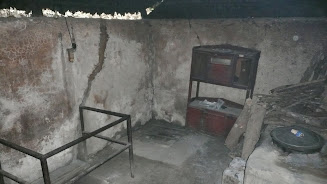 |
| Comfortable underground kitchen with easy access to a tunnel, The opening with the fence around it to protect tourists. |

Of the many myths and truths from the history of the 1950s-1970s, one at the top or damned close to the top of any list is the Vietnamese guerrilla war area called the Cu Chi tunnels. Leanna and I got to visit the national military reservation or park that contains the tunnels and related historic displays. We have heard repeatedly since our arrival that the people of Cu Chi are a special source of pride and inspiration for all of Vietnam. We visited three different park areas and drove by several more. Following are our impressions and some of what we learned about this amazing history.
The
town of Cu
Chi lies north and west of Ho Chi Minh City but seems like a suburb
because the spread of HCMC
is so extensive. After about an hour's
drive we turned
off the main highway to follow a smaller
highway for a few miles. We
pulled
into a military area and parked next door at a large restaurant –
at
the banks of the Saigon
River. You
pass through a large, modern tunnel to enter the actual Cu Chi
preserved/restored park and tunnels.
After emerging in the park area we joined with a group of Malaysians to make a tour group lead
by a
young man dressed in khaki green. The first tunnel we looked at was
entered by a SMALL rectangular
hole that a person
could drop down into if the alarm were given. I dropped in to have a
look-see but it was immediately evident that I couldn't go out into
the tunnel that connected to the entrance, it was too small for
someone my size (about 5'8 1/2 and 150 lbs – I have lost weight
since coming to Vietnam) but our guide told us that there
were tunnels enlarged so that tourists could share some of the
experience of moving and “living” underground. Just
a couple of awe inspiring facts: the Cu Chi underground was built by
Vietnam patriots (regular
working people men, women, children of all ages) from
the Cu Chi area in the years from 1948 to 1965 although it was used
right up to the fall of Saigon in 1975. The people of Cu Chi are
proud of their ancestors and martyrs who died in the war of
liberation as well of the tunnel network they built to help defeat
the French and the US. Maintaining
the Cu Chi area free of USA control was seen as vital to the
liberation of Saigon. The
underground tunnel network totaled 200
kilometers, or about 120
MILES! This matrix was built by human toil,sweat and blood without
big fancy machinery but hand tools: picks, shovels, wheel barrows, a
bamboo
woven carrying
device that looked like a cement hod and the like. The tunnels were
constructed at 3 levels: the fighting level was at about 6 foot
underground and was constructed so that Viet Cong in their “black
pajamas” based on a traditional clothing style of the country folk
called an ao baba, a cousin of the ao dao (ow zi, the i is pronounced like a long i and the d is pronounced as a z more or
less) could fire on the enemy and when things got hot dive in the
tunnel and crawl to another port hole where they could pop up and
continue to fight or flee to fight another day. The tunnels were not
constructed in straight lines but had twists and turns to stop the
force of explosions and prevent the deaths of the soldiers and
support personnel in a tunnel (the
blast would run into the wall and be weakened but there were still
casualties).
The brave US troops would spray flaming petroleum fuel into the
tunnels with flame throwers in their attempt to defeat the enemy. Of
course they killed old people, women and children burning them alive.
And in the US we have heard about the tunnel rats of our US Military
who would brave the tunnels seeking the enemy but the enemy had
disappeared by the time the GIs went down into the tunnel and this
saved many American lives. On the other hand there were many booby
traps that injured our US troops. In one building we were given a
lecture on several types of booby traps that were deployed against
the invaders. The main thing that can be said is that traps were
made from local materials such as bamboo, other forest products, and
the technology the people had used for thousands of years to trap
animals. [Now as the guide said they trapped the enemy]. The Viet
Cong also re-manufactured captured French and American bombs, cannon
shells, other weaponry, rockets, tires, blown-up tanks and other
vehicle parts etc to make weapons in factories in the tunnel complex.
Our guide stated that “We recycled everything”, it made you
think of an ecology group getting a tour on recycling except in your
eye you saw weapons being cut to pieces and then re-assembled into
much less sophisticated but effective weapons. There were as we
mentioned two more tunnel
levels,
one at about 10 foot and the other at about 18 foot depth. Parts of
the “fighting
level” could be destroyed with cannon fire or grenades so when
under attack the Vietnamese could drop down slanted entries to the
second level where they were safe from most weapons. The lowest
level at about 18 foot were safe from the carpet bombing of the B52s
with 500 kilogram bombs. At this level people could survive terrible
weapons of mass destruction although casualties were enormous. There
were 47,000
military
deaths
(does
not count all the civilians) in
this small area, almost equal to the total of all Americans killed
during the war.
 |
| Trying out a tunnel entrance, not much room. |
All
of life was not spent underground. The village of
Cu Chi,
original
population
18,000, had dug out buildings/bunkers
for tunnel workers and their families, schools for the children, a
small hospital, eating rooms for communal meals, kitchens, weapons
manufacturing areas where we watched how American bombs were turned
into weapons to fight the invaders, a clothing
and “shoe”
manufacturing plant where the workers turned used tires into sandals.
While we watched an operator used the equipment to make shoes like
the ones that I bought. (The sandals I bought are made from recycled
pieces of auto tire for the sole and heel and inner tube strips for
the top straps. I put them on and worn them them the rest of the day
to walk a mile in another persons shoes
to know her life in
a small way.)
The living quarters and other buildings now rebuilt are both above
and below ground level so that us tall foreigners can get in and out
easily, but in the day the buildings did not protrude above ground or
just barely above ground level so that the jungle canopy would make
them invisible. Not protruding above ground also offered some
protection from the blast of bombs that exploded near by – the
blast would travel horizontally above the dug out buildings and the
building would survive to be used again. The folks in the buildings
would run into the tunnels as soon as there was an alert and head
down to safety. Every building had an alarm or alarms made of pieces
of bamboo that could be struck with sticks to make a racket and warn
other buildings. Indeed
sections of the tunnels have been enlarged for people Leanna's size
and equipped with electric lights so that you can careful climb down
into the first two levels of the tunnels and move through the tunnels
for around
150 feet. Even that short distance is overwhelming in a crouched
position when you know you're headed toward an exit. Incidentally
we saw a lot of bomb craters left from the carpet bombing by B52s and
other US aircraft. Chemical warfare was used extensively on Cu Chi
--- is Henry Kissinger and our generals and officer staff up there
with Adolf Eichman and the other NAZI swine? You will have to answer
but it is a hell of a question. As I remarked recently on Facebook,
our troops shouldn't be put in the position of killing others to
satisfy the desires of the ruling classes of our nation – who make
damn sure their kids don't go, [think “Dick” Chaney and George W.
Bush for example.].
The
second area we visited was a reconstruction of the original Cu Chi
village so we could get a feel for the history of the area and people
from 1960 through 1975. First we saw typical bamboo-sided, thatched
roof houses with rooms for sleeping, cooking, eating with storage as
well as wooden houses of similar size but made with sturdy wood and
more substantial furniture – the relatively rich. There were
plentiful fields of rice and vegetables, grazing, bamboo, livestock.
A school was proudly built and in full use by 1965 for the village
children. There was a market, village meeting house and a modest
health clinic. After the defeat of the French colonialists, the Cu
Chi area remained solidly Viet Cong/anti-USA imperialism so the
tunnel system connected all buildings, houses, public areas, work
areas, school and clinic. As we continued walking we entered an area
depicting the village during the increasing USA war when heavy
bombing and troop invasions took place. At
this point houses and buildings became bunkers as described above all connected by tunnels. Since
this USA strategy of
carpet bombings and toxic defoliants did
not stop the Vietnamese resistance in Cu Chi, the USA then
constructed concentration
camps and attempted to force the people of Cu Chi into the so-called
“strategic hamlets.” The USA then used more carpet bombing,
Agent Orange and bulldozers to demolish
the land, vegetation, village above ground structures, etc. As we
walked through the area of bomb craters, un-restored land and
destruction and desolation dotted with tunnels, it was sobering. Yet
the people of Cu Chi continued to fight off the USA military and
provide a launching area for successful liberation using the tunnels
and their creative commitment to independence, freedom and happiness.
Today 38 years later it is amazing to see bamboo and other trees
(peanut, rubber, fruits, etc.) growing again with healthy vegetables,
rice fields. The resilience of Vietnam's people and land is
inspiring.
Our
final stop was the Ben Duoc Martyrs' Memorial built from 1993 until
1995 as a tribute to the more than 47,000 military dead from the
area. We were visiting on an anniversary day of the Vietnam military
so there were special ceremonies honoring the heroes of the American
War. It was very moving to see the huge statue of Ho Chi Minh and
the innumerable golden plaques listing each dead revolutionary. The
outside walls of the memorial was covered with beautiful mosaics
depicting the history of Vietnam. The buildings are surrounded by
quiet gardens with many trees planted in memory of individual
soldiers as well as a large fountain shaped like the lotus flower –
the entire memorial overlooks the Saigon River.
There
were many times during the Cu Chi visit that were painful and
uncomfortable for us as Americans. The
guides and installations were very straight forward and we were
treated with sincere respect. The facts spoke for us. There
were also moments of intense inspiration at the strength, resilience,
depth of political commitment, vision and thirst of the Vietnamese
people to win and shape their own future. We came to Vietnam
thinking we had a solid foundation and understanding of the history
of Vietnam. Cu Chi has taught us that there is so much more to learn
about and from the Vietnamese people and their examples for the world
historically and now.
We will share more pictures in a second post on this subject in the next few days.
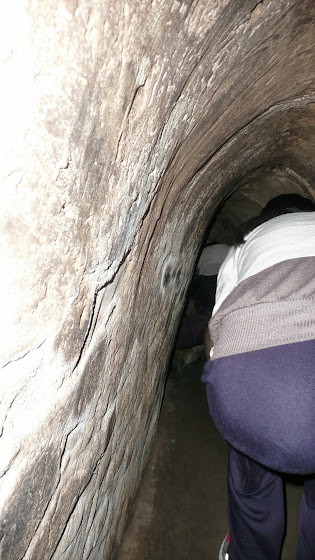 |
| The woman ahead of me moving through the enlarged tunnel, made so us big people can get through! |
 |
| The hole at the top right into the wall of the room is a tunnel entrance, original size and I can't picture myself trying to run from falling bombs into that tunnel, but people did it to survive. |
Wednesday, December 18, 2013
Out to the countryside: Provisional Revolutionary Government and Black Lady Mountain!
 |
| House of President Pham Van Dong, President of the Provisional Revolutionary Government and later of the Unified Republic |
While the armed struggle and diplomatic work of freeing Vietnam from
French colonialism and American imperialism took place, the
Provisional Government of South Vietnam (the real one, not the USA
puppets) functioned in the jungle passing laws, implementing a new
economy and building a free, unified Vietnam in coordination with the
Viet Cong Peoples Army. In spite of US military spraying of
thousands of tons of Agent Orange, dropping millions of pounds of
bombs and committing more than 625,000 troops at one point trying to
defeat the people of Vietnam, in the end the Provisional Government
and People's Army WON! During many of the years of struggle in the
jungles of western Vietnam's Tay Ninh Province at the Campuchia
border, the Provisional Government made its plans and ran its
people's government and war committed to victory and liberation, no
compromise, no defeat. And we got to see a replica national monument
of such a location during a recent day trip!
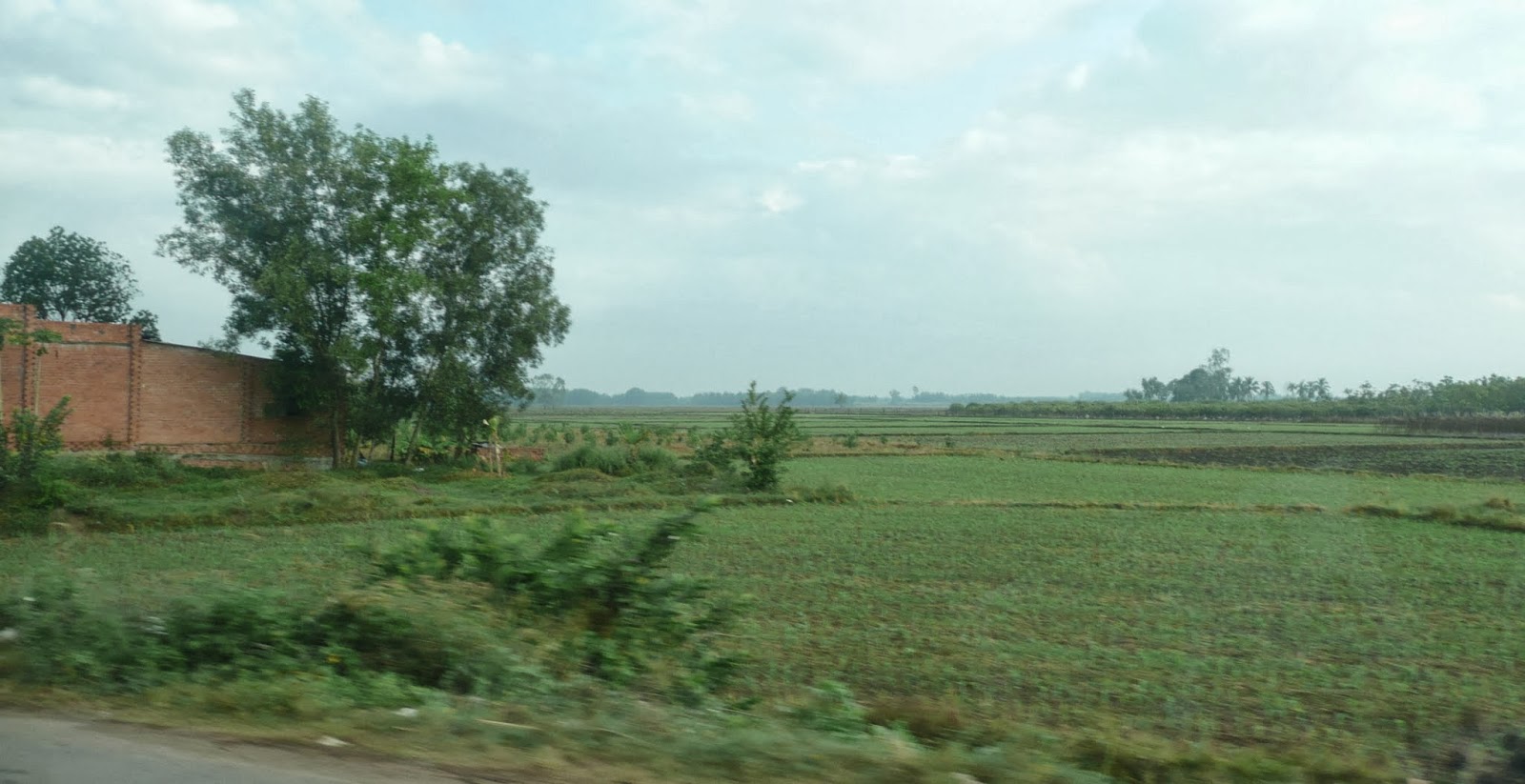 |
| Country side in the frontier area near Campuchia in Western Vietnam, Tay Ninh Province |
December 15th Leanna
and I had the opportunity to visit this historic site with Ms Vinh
and a TDT driver. It took a couple of hours of driving to reach Tay
Ninh and the Black Lady Mountain, a beautiful mountain with several
pagodas built along its sides – the mountain is surrounded by
fields of rice, vegetables, rubber trees, fruit groves – a real
vista which also included a LARGE lake. The Black Lady Mountain is
well known to religious and sightseeing Vietnamese. In March the
park and mountain trails are very crowded. The monks in the pagodas
manufacture herb medicines on site. People younger and more fit than
us will spend the three to four hours to hike up the mountain, but we
took the cable car to the terminal at the first and largest pagoda
probably 3/4 mile in elevation change. Then we walked up steep stone
steps for probably another ¼ or more mile visiting three more
pagodas and historic sites. The cable car was fun with an incredible
view of the mountain and surrounding lands – LARGE farming valley
of the area and a beautiful lake in the distance.
 |
| Pagoda on Black Lady Mountain |
 |
| Memorial to Viet Cong soldiers who died defending the mountain from the American invaders. |
It is noteworthy
that the young people sprinted past us on the darned steep stairs, oh
the exuberance of youth and childhood when scampering up mountains is
just a big lot of fun. Another woman was taking the mountain using
both hands and feet to make sure that she eliminated or at least
reduced the chance of falling. We were already on the way down so I
didn't give her method a try then but who knows what will be on the
next mountain? Oh, a great insight, walking down steep mountain
stairs is easier than walking up the same steep stairs, duh. When we
had come off the mountain there were a lot of tourist shops open
selling local foods and other gift items, so we bought some to share
with students and other faculty at the University.
Of course we also
ATE delicious food in Tay Ninh Province starting with an early lunch
in a small cafe run by a village woman – great bowls of pho bo and
bun bo Hue. Tay Ninh is famous for soup shops and they deserve the
credit that they get. Tay Ninh soups are made with fresh meat, fresh
greens and other vegetables and good rice noodles made by either the
proprietor or at a local noodle factory. It seemed that we had
already carried out a full days touring but it was only noon (We had
climbed into the van and hit the highways at 6am.).
Full, we headed back
south and east but still paralleling the frontier with Campuchia.
There were many farm tractors pulling loads of cut bamboo and other
crops on the highway – like in the US in rural areas tractors have
the right of way on the two way hard top roads and dirt roads of the
countryside, they make for exciting motoring what with the big
trucks, buses, and schools of motorbikes. Then there are the buffalo
munching away alongside the highway as well as chickens, dogs and
cats, geese, and egrets (probably a few pigs too but I didn't see
any). We also noticed for the first time traditional fishing rigs
all along the banks of the many canals, creeks, small rivers and
larger rivers. After a few kilometers we took a right hand turn down
a narrow road heading toward the Campuchian border This was
definitely getting off the beaten track, just some farms here and
there. Ms Vinh said that we were on the way to a historic location:
the site of the provisional revolutionary government.
Furious fighting
took place in Tay Ninh province as the US and the puppet army of the
Republic of (South) Vietnam fought to dislodge the Viet Cong and halt
imports of material support for the
 |
| Plans made for the capture of Saigon, now HCMC, by the PRG and the National Front for the taking of Saigon in 1975. The map tells the story of the movement from North to South and through Campuchia and Laos of men and materials. |
“It
was named by the Americans for North Vietnamese president Hồ
Chí Minh.
Although the trail was mostly in Laos, the communists called it
the Trường
Sơn Strategic
Supply Route, after the Vietnamese name for the Annamite
Range mountains
in central Vietnam.[1] According
to the United States National
Security Agency's
official history of the war, the Trail system was "one of the
great achievements of military engineering of the 20th century."[
Just FYI the trail
was not one super highway but many dirt trails that were large enough
for some smaller trucks, bicycles, buffalo carts and thousands of men
and women carrying materials on their backs or with carrying poles.
When you walk in this jungle you realize the amazing effort made by
the Vietnamese to carry out their liberation struggle. The sacrifice
to reach freedom liberation reportedly cost somewhere between 2 and 4
million lives over the years and in a country that at that time had
maybe 50 million people that would have been about 4 to 8% of the
population, or about 12 to 16 million of the American population.
 |
| One of the fabled tunnels, with top removed but you can see the top in the left background and where it goes under the house. |
The Provisional
Government Headquarters was hidden in the forest/jungle (Leanna has
the mosquito souvenirs to prove it!). The site has a small museum
and trail map that helps guide you through the scattered buildings
which include a president “house” and vice president “house”
- both were thatched, open sided buildings only large enough for a
small bed, drawers, writing table.
 |
| Kitchen to prepare food for the government and troops. |
 |
| The hospital to treat ill or wounded |

Like many frontiers,
a duty free commercial area has been functioning here for quite a
while. We checked out several stores and were amazed at the shopping
crowds! Busy!
On the way back to
TDT our driver recommended not only a wonderful restaurant for banh
trang and banh canh (great rice paper wrapped pork rolls with special
fish sauce and great soup) but also a VERY BUSY little cafe where we
enjoyed khoai mi and a special version of ngoc mi (coconut drink).
Khoai mi is the tuber vegetable that was the basic food for Vietnam
during the many war years. We keep eating our way around this
marvelous, delicious Vietnam!
 |
| A corner of the hospital and the escape tunnel necessary to protect patients and staff from US bombing. |
Beautiful scenery,
warm and friendly people, inspiring history, fresh and delicious food
– we are so happy in Vietnam. Until next adventure, greetings to
all!
Monday, December 9, 2013
EOS (endofsemester), Green Day and Mekong Delta here we went!
 |
The Green House for
GREEN DAY
|
Our
Vietnam Experience was FULL this past week with the final classroom
sessions of our two classes, a GREEN DAY event organized by students
from Business Administration, coffee and dessert with two friends who
are coaching us in Vietnamese, and Leanna seeing Hunger Games 2
movie with students (while Hollis grumped at home and didn't go to
the movie). Yesterday, Dec. 7th,
we took an out-of-town trip to the Mekong Delta area in Tien Giang
Province, My Tho City and Ben Tre. The trip inlcuded a boat ride on
the Mekong River to visit two islands, learning about a new part of
the country, shooting pictures, having fun and eat too much great
food.
 |
| THE WATER TO THE LEFT IS NOT SUPPOSED TO BE THERE, THANK YOU GLOBAL WARMING |
We saw first hand some of the problems caused by global
warming as we passed an area that was flooded by high tide, an event
that happens more often now with more serious consequences. Yes
friends, global warming is real and its effects are precipitating
serius problems for folks living close to sea level.
Last
Monday and Tuesday we taught our last two regular classes for the
semester and one “make up” class on Thursday to fill the void
that was left when our interpreter was not available a few weeks ago.
All the classes were successful as we reviewed course materials in
preparation for finals which begin Dec. 9 and go on for two weeks.
 |
| LEANNA ENJOYING STUDENTS DURING THE GREEN DAY |
Overall we are happy with the semester even with the challenges that had
to be overcome on the fly. TDT's support has been GREAT! Of course
we don't know yet how our students will do on their finals but we're
hoping for the best! This has been a challenge for the students as
well -- dealing with some USA content as well as the challenges of
translation. As they heard more English as the semester progressed
it was fun to watch their comprehension and comfort levels with
Englsh improve.
What's
next...our inability to learn much Vietnamese has been a
disappointment, but that's the reality. We're hoping a couple of
patient friends can help us learn some basic words and phrases to
help with travel around Vietnam in late December, January and
February.
 |
| The students raise money on GREEN Day to support their activities. NOTE THE DREAM CATCHERS |
The University will continue to provide us with a room
while we remain in Vietnam. It provides us a base of operations to
scurry around and then come back home to our "home away from
home." Meanwhile, various University projects will give us a
chance to continue our contribution to TDT. We have helped with
documents and web site translations. We're also enjoying
conversational English sessions with faculty members.
TDT
invited us (and we accepted) to join the international lecturer staff
of the University, which means we will have the opportunity to return
to Vietnam in the future to lecture at the University for a few days
to months. This is really exciting for us since our position would
provide us with sponsorship and the accommodations necessary to do
more volunteer work.
Last
Wednesday the students from the Business Administration Department
produced a great event Green Day highlighting the need to create a
GREEN world to ensure the survival of our species. We're including
Green Day pictures. Leanna is a big hit here, everyone wants to get
a picture with the American teacher. I get my share of that from the
students, too, and maybe we'll include a picture of students who
stopped me on the way to our office and asked me to have a picture
with them. Many friends may remember that I used to shy away from
having my picture taken but it was time for a change and change I
have. I am even eating fish and chicken though I am still afraid of
bones getting caught in my caw. Fresh fish here is very tasty --
check out the photo from the Mekong Delta of a delicious Elephant
Fish we had at lunch along with coconut steamed rice (outrageously
good), a hot pot fish soup, shrimp cooked in coconut milk, green
vegetables that we dipped in a fish sauce: need I say more about this
lunch.
DELTA
HERE WE COME!
 |
| At the My Tho boat dock waiting to board and on to the islands. |
Our
driver picked us up at 7:30am on 7/12/13 for our trip to the gateway
to the Mekong Delta, the city of My Tho in Tien Giang Province,
across the river from Ben Tre. At My Tho we boarded a small launch
that took us to visit two Islands: Unicorn Island and Phoenix Island.
The first island is a part of My Tho and the second is part of Ben
Tre Province.
On
Unicorn we relaxed at a tea house with “honey tea” made with bee
pollen, honey, fresh lime juice and tea. The tea was served with
dried banana, ginger candy, and other traditional snacks. We bought
several scrumptious items to share with the staff back at the
university.
 |
| Modeling this years Boa, beautiful neck adornment |
Further along the island we and made port at a coconut
candy workshop where we again tasted the product and bought stuff to
share with our friends back on the campus. At one stop Leanna took a
look at a traditional musical instrument and the musician loaned her
a pick so she could hit some notes -- after we enjoyed some beautiful
traditional-style music and singing.
Next we boarded a SMALL canoe
for a paddled trip down a channel to meet the Mekong rendezvous with
the launch. The small boat was rowed by a man and woman who seemed
pretty expert to me at following the quick moving channel without
stress. Back on the larger boat we crossed more of the MeKong River
or 9 Dragon River to Phoenix Island. As we headed out into the Mekong
the boat man let me take the tiller for a (very) short ways so now I
have bragging rights, “I piloted a craft on the 9 Dragon River.”
Whoa!
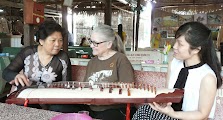 |
| Leanna getting music lessons while Ms Vinh pays close attention. |
 |
| Piloting the mighty MeKong |
 |
| ELEPHANT FISH -- MMMM |
 |
| Fancy Dining -- multi-course course on
Vietnamese eating on the Mekong
|
On Phoenix Island we had our multi-course lunch featuring Elephant Fish and other delights that I mentioned earlier. During lunch we learned that our driver was a military veteran and had seven bullet wounds while serving. That was a sobering bit of information and set us to thinking while we ate – it is hard to comprehend what it must have felt like to get hit by a burst of seven bullets. After we ate our big lunch we took a foot tour of the Island and marveled at the size of the Mekong. We had only crossed two of the 9 dragons and each was larger than most rivers that we experienced such as the Mississippi, the Missouri, and the Snake and Columbia Rivers in the Pacific Northwest. We have no idea of the total volume of water carried by the Mekong but it is a lot. The Phoenix Island is famous as the location of the Coconut Monk who was imprisoned many times by the South Vietnamese because of his work for peace.
 |
| Posing outside the Snake Zoo |
Monday, December 2, 2013
Blogging the work week. Finals are almost here! And Leanna the Judge!
Blogging
the work week. Finals are almost here! And Leanna the Judge!
 |
| Dean Loan of Finance and Banking presents awards to the Fantastic Four, the overall First Place Team in the competition. |
The past two weekends Leanna participated in a “panel
of judges” for a student organized competition with cash rewards
and scholarships – the major goal was to encourage and challenge
students to use English in writing and speaking while strengthening
their vocabulary.
The competition was organized by the Banking and
Finance students and open to all TDT students – 400 of whom
initially participated with written English essays. These were
screened by the student organizers and selected lecturers. Leanna
began her work with the “semi-finals” of 24 students who made
public speaking presentations in English as well as handling Q-and-A
with the panel of judges. The panel of judges then selected the
final 12 competitors who were placed into 3 teams of four contestants
competing for 3 levels of prizes. The final competition included a
bingo-style quiz, timed Q-and-A and a role play simulation of a
challenging business situation. Each of the teams did really well
(each team had a name, special colors, decorations and a slogan).
The 1st place winner was the “Fantastic Four.” There
were really no “losers” because all top Twelve

The Blue Birds team receive their awards for the excellent work
they accomplished from Lecturer Leanna.
participants
received a cash reward and a scholarship reward and plenty of
recognition. What impressed Leanna was not only the English-speaking
ability of the students but that regardless of departments such as
Foreign Language, Business Administration or Banking and Finance, the
student perspective was NOT to be a millionaire and drive a fancy
car, but rather how to combine respect, quality, effectiveness and
other values to help build Vietnam's economy for the benefit of all.
It was also impressive to see the planning skills, analytic skills
and hard work of the students who organized the competition.
they accomplished from Lecturer Leanna.
The
past week and this week are all about final class sessions and review
with students for final exams which begin Dec. 12th –
two weeks of exams. One or two last chances to encourage students to
make their contributions to strengthening the VGCL and VN unions!
Lecturers do NOT administer the final exams nor do we know the
specific questions that will be asked. Rather, as is done here at
TDT for mid-term exams, there is special staff of the university that
proctor the examinations using a very strict regimen. It seems as
though this process is to eliminate any appearance of favoritism.
Numerical identification connects the answer booklets to the exam
taker so that the entire system compartmentalizes test-taking away
from the lecture hall except for the exam content.

UCLA Labor Center poster that hangs in the Department Office and Leanna's temporary display of our Certificates of Achievement awarded by the President of TDT University at Teacher's Day
Of
course we have a good general idea of what will be asked since we
taught the course and contributed a whole host of possible questions.
All that aside our last few shifts we have been concluding our
lectures; having our students do many simulations of the situations
that they may have to deal with in collective bargaining, conflict
resolution, grievance handling, social dialog, mediation,
arbitration, etc.; stressing strategy and analysis; basic process and
skills; Vietnam's Labor Code and Trade Union Law. Basic content here
in VN also includes theory, human behavior, social and economic
factors, team building, etc. Our experience is that we were able to
cover more material per class than we originally thought possible –
having a GREAT interpreter knowledgeable about labor made a big
difference so that Ms. Vinh not only handled document and classroom
translation but helped bridge our knowledge of VN economics and labor
law. With Ms. Vinh's help we devised a strategy of having teams of
students prepare presentations on each critical topic from the
Vietnam experience/perspective so most class sessions were a
combination of us and students educating together utilizing
PowerPoints, discussions and simulations.
To-date
feedback from students, Ms. Vinh and other faculty has been positive.
We will see what the final exam and evaluations add to the picture!
Friday, November 22, 2013
***** AMAZING Teachers Day in
Vietnam *****
 |
| Student Dancers from LDnCD |
********* National Teacher’s Day – Wow! ***********
 |
| Teachers Day begins with a ceremony at the front of the University |
Then, almost magically a group appeared carrying signs on
sticks and people began lining up by the signs.
Leanna and I had no idea what was happening and then Vinh, our
extra-ordinary friend/fellow lecturer/interpreter/translator explained now
people were forming up in new lines to take part in the athletic competitions
among the entire faculty (except for students). 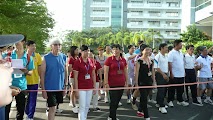 It was strongly suggested that
I join the “running” event and after some cajoling (yeah, right – Leanna commentary)
I consented. The course was probably 2/3
of a kilo and I enjoyed running with my new friends from Vietnam. I won a prize as the eldest competitor. Students began joining in the fun as
spectators, fan clubs, helping with logistics, etc.
It was strongly suggested that
I join the “running” event and after some cajoling (yeah, right – Leanna commentary)
I consented. The course was probably 2/3
of a kilo and I enjoyed running with my new friends from Vietnam. I won a prize as the eldest competitor. Students began joining in the fun as
spectators, fan clubs, helping with logistics, etc.
It was strongly suggested that
I join the “running” event and after some cajoling (yeah, right – Leanna commentary)
I consented. The course was probably 2/3
of a kilo and I enjoyed running with my new friends from Vietnam. I won a prize as the eldest competitor. Students began joining in the fun as
spectators, fan clubs, helping with logistics, etc.  |
| Ms Vinh and Hollis on tandem bike. |
 |
| Our Dean, on the left, playing football. |
 Now it was time to watch others “sporting” and we watched our Dean, Professor Hoa, play football ( aka soccer in the USA) for the Biz Adm team
since he also lectures for them. The game was fought furiously and it was
getting hotter and hotter out on the field but after about an hour the other
team pulled out a victory. Final event
was the “fishing contest” where Mr. Quang (LRTU Administrator) and Ms. Hien (recent
graduate and probationary worker) represented our department. The fishing event was a wild affair held at
the canal that cuts across the campus.
Alas our fisherman was assigned to the southeast side of the canal and
the fish weren’t biting.
Now it was time to watch others “sporting” and we watched our Dean, Professor Hoa, play football ( aka soccer in the USA) for the Biz Adm team
since he also lectures for them. The game was fought furiously and it was
getting hotter and hotter out on the field but after about an hour the other
team pulled out a victory. Final event
was the “fishing contest” where Mr. Quang (LRTU Administrator) and Ms. Hien (recent
graduate and probationary worker) represented our department. The fishing event was a wild affair held at
the canal that cuts across the campus.
Alas our fisherman was assigned to the southeast side of the canal and
the fish weren’t biting. |
| Our Fishing team,Mr. Quang in front of Leanna and the woman to the right side in high heels, Ms Hien. |
Once the fishing contest was over we rushed back to our room (everyone else used offices and bathrooms! )and got into serious clothes again to be ready for the 3pm Convocation where honors were handed out to many of the instructors by the University President and Vice-Presidents after a moving student performance including several from our department.
 Leanna and I were presented certificates for
our contribution to the internationalization of Ton Duc Thang University as
part of UCLA Labor Center’s ongoing international solidarity work– it was such
an honor in front of the faculties and students. To work at a University named for the first
President of the Socialist Republic of Vietnam who was also an educator and a
comrade in arms with Ho Chi Minh – wow! Ton
Duc Tang is known as a revolutionary leader who taught literary and politics to
fellow revolutionaries while imprisoned by the French. You can jail the revolutionary but you can’t
jail the revolution!
Leanna and I were presented certificates for
our contribution to the internationalization of Ton Duc Thang University as
part of UCLA Labor Center’s ongoing international solidarity work– it was such
an honor in front of the faculties and students. To work at a University named for the first
President of the Socialist Republic of Vietnam who was also an educator and a
comrade in arms with Ho Chi Minh – wow! Ton
Duc Tang is known as a revolutionary leader who taught literary and politics to
fellow revolutionaries while imprisoned by the French. You can jail the revolutionary but you can’t
jail the revolution! |
| Thêm chú thích |
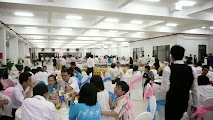 The buffet was an amazing selection of seafood, fish, vegetables, beef
and pork, bamboo sprouts, and on and on plus excellent Saigon Beer for toasts to
teachers, education and Vietnam. It was
a real gala event for everyone on campus.
The buffet was an amazing selection of seafood, fish, vegetables, beef
and pork, bamboo sprouts, and on and on plus excellent Saigon Beer for toasts to
teachers, education and Vietnam. It was
a real gala event for everyone on campus. |
| Our Table Salutes Teachers Day |
Check out the Ton Duc Thang University HCMC website, http://tdt.edu.vn/, where you can click on the British Flag in the
upper right hand corner for an English translation. Not only will you see information about
Teachers Day but you can get other information about TDT.
Subscribe to:
Comments (Atom)