Tuesday, January 21, 2014

Nghe An and Tuyen Quang Provinces – Famous for Beauty and Leaders

Nghe An and Tuyen Quang Provinces – Famous for Beauty and Leaders

Motorbike Collection
Following is a photo essay celebrating the creative use of motorbikes by the talented Vietnamese drivers! Below you can see “cargo” ranging from pigs, orchids, Tet trees, ceramics, building supplies, fabric – any and everything that is strap-able and can be balanced (talents!).

Tet flowers on the way to market.
What do you mean, big load?

Got anything more to deliver?

You are hogging all the space.

Delivering paper to market, paper is
a big industry in the forest area.

This little piggy goes to lunch and this one ...

Delivering ceramic ware.

Orchids for a celebration or just for beauty.


Murals and Mosaics
Both Hanoi and Vinh have GREAT art – Hanoi is home of the largest mosaic in the world created to celebrate the 1,000 years birthday of Hanoi. And Vinh greets you with a beautiful mural/mosaic at the airport.

Hanoi, city of a thousand years that they celebrated
in 2010 with the production of a several kilometers
long mural on their main city freeway.

Vinh's airport mural celebrating a visit to the
city by Ho Chi Minh City during the war in
a small two engine aircraft.


As we visited the area where Vietnamese leaders launched the 1945 revolution declaring Vietnamese independence, we saw the North's beautiful countryside, rural mountains and villages. Check out the following photos and captions for a glimpse.


Home made. hand made noodles at the market.


Ho Chi Minh's Childhood Homes
Nghe An Province has long been known for its smart people and leaders, so it is no surprise that Ho Chi Minh was born here. His family story is somewhat unusual in that his poor father was a great intellectual whose mentor and teacher was so impressed that he suggested the poor student marry the teacher's daughter and that the couple live with the teacher's family (usually the couple would have lived with the paternal family).
House where Ho Chi Minh's maternal grandparents lived.

First home of Ho Chi Minh.

Inside Ho's first home.
 Vietnam has lovingly preserved both the house of Ho Chi Minh's maternal grandparents and the next-door house built by these grandparents for HCM's parents where HCM was actually born. Both houses are typical architecture. When HCM's father passed his national exams, his paternal family village was so honored that they built HCM's father a new house close to his paternal grandfather's home. So HCM and his family then moved to the nearby paternal family village – which has also been carefully preserved. Surrounding both sites there are still the villages living daily routines so that you really get a feel of on-going village life while visiting these historic sites.
Ho Chi Minh's father's house built by his village
to honor his high scholastic achievement -- 2nd score
in the nation.

Another shot of the family's second home.

In the garden by the first home of Ho Chi Minh with
his maternal grandparents family. 


Tan Lap – Village of Revolution
While we were traveling to Tan Lap our guide mentioned that he had never been asked to take foreign tourists to see this historic site and alerted us that people in the area and Vietnamese tourists would probably be amazed to see two Americans. It's true that we were the only foreign faces and people were so friendly and welcoming, eager to share stories. The mountains, lake, hills and forests of Tan Lap are home to an ethnic group and ancient village that welcomed and supported the Vietnamese revolutionaries dating back to the struggle against the French as well as the USA. The landscape is incredibly beautiful and undeveloped even today (although lots of logging is taking place).

Ho's hidden mountain hut where he formulated plans for
the successfully defeating French colonial forces.

House where Ho Chi Minh stayed in the village.

Village meeting house, note the loud speakers used
for daily announcements and news.

House where General Giap lived and worked in the
village.

Tan Lap Village of the local ethnic group
who hosted Ho, Giap, and the revolution.

Historic banyan tree.

Planting new rice just before or just after Tet.

Tea fields on the hills.
 The region is famous for tea. Under an old banyan tree (it was 300 years old before it finally died in 2008) General Giap announced the formation of the People's Army. Along with other revolutionaries including at times HCM, plans were made here to form the new, independent government of Vietnam in 1945. Before the old banyan tree died successful grafts were made so that the old stump is now surrounded by newly-growing trees to make this historic site. The village houses where General Giap and HCM lived as guests of the resident families still stand and are occupied today. Later HCM successfully evaded the French by living in a small hut nearby and directing the on-going war against the French colonialists. It was amazing to be able to see the areas where these great leaders lived and worked – hiding in plain sight with the support of the people and villagers of the area.


HCM Trail Museum
When we first read about this museum, it was described as being located south of Hanoi. Our experience driving to the museum is that Hanoi has rapidly grown and developed to now spread out to the museum. We passed impressive construction of the Hanoi monorail along with lots of TALL buildings and skyscrapers.
Mono-rail construction

Entrance to the HCM Trail
Museum.

Statue honoring the soldiers of the trail.

Scaling cliffs along the Trail with
bamboo.

Carrying heavy loads over rock, water
and any obstacle.

Pack Elephant.

Famous hero woman who carried
a load of 70 kilos when she only weighed
about 45 kilos.

Rope ladder used on the Trail

Meetings on the road, this one with General Giap.

Bridges made of any available material to
get supplies to the troops in the south.

Communications equipment used on the Trail.

Camouflage over the Trail to keep moving day and
night under threat of USA bombing.
This museum is an amazing tribute to the bravery, tenaciousness, brilliance and creativity of the Vietnamese to patiently construct, defend, maintain and expand a network of land and water routes the entire length of Vietnam to transport troops, distribute food, provide health care, transport and mobilize weapons, build a fuel/oil pipeline and construct an elaborate and effective communications system which supported the revolution for independence and socialism. We thought we knew a lot about this effort – and were WRONG! Both the museum exhibits and an amazing DVD and diorama/diagram provide incredible facts, materials and stories to bring this impressive accomplishment of so many Vietnamese people alive. Our tour guide added his own father's stories as a HCM Trail soldier to what we learned form the museum.


The people, history and land of Nghe An and Tuyen Quang Provinces will stay with us forever! We hope many of you will get to explore here as well.

Monday, January 20, 2014

Con Dao Island: Hell in Heaven!

In the first two weeks of 2014 we visited Con Dao Island, the City of Vinh and the birthplace of Ho Chi Minh , Tuyen Quang in the Northwest highlands and finally the Ho Chi Minh Trail Museum just a bit south of Hanoi. On January 25 we take a final trip to Sapa, HaLong Bay and Hue. So now some highlights from our most recent trips.

100 years old and still weaving her story.
    As we've traveled we seen the diverse and dramatic beauty of the country and met so many warm and friendly people. Almost everyone calls out “hello” to us in English and the children delight in greeting us with shouts of “hello, hello.” Some folks with more English often ask where we are from so we often have brief conversations with many folks. One new acquaintance with whom we spent a few minutes and took some photos was a woman who proudly told us she was 100 years old! She had asked us how old we were and we thought when we said 74 for me and 63 for Leanna that we were being impressive, but she proudly declared her age of 100! She was perched on a stool next to the rural roadway with her grand-daughter and great-grand daughter weaving baskets out of bamboo and selling fruit (she explained her baskets are for carrying piglets and/or chickens to market on motorbikes). The granddaughter was selling ‘Buddha hand’ fruit especially popular at Tet. Of course our talented tour guide, Nang, translated for us. The woman spoke with pride about Uncle Ho and the Vietnamese evading the French.

Con Dao Islands are about a hundred miles east off the southern end of  
Map of French Prison inherited
and used by USA 
 Vietnam in the East Sea at about 8 degrees north latitude.
These islands are pristine beaches, ocean and forests with small towns relying now on agriculture and developing tourism. Our guide Thanh met us with a car at the airport and was very informative. The small town was easily walkable with a typical open market and friendly folks. The population of the island is around 7,000. Behind our hotel (all over the island) were prison walls. We had known that this was a huge colonial prison run by the French colonial government from 1851 onwards to imprison political prisoners, anti-colonial activists, and some common criminals until the French were defeated by the Vietnamese at Dien Bien Phu in 1954. The conditions under the French were horrific – forced labor, no fresh water or food, overcrowding, no medical care, torture and the infamous French Tiger Cages


   where in addition prisoners were dusted with lime and then hosed with water to cause chemical burns. After the French, the puppet regime established in Saigon by the Roman Catholic Church and the US continued to use to prison to torture, mutilate, starve, work to death and kill political prisoners who were mostly Viet Cong and National Liberation Front leaders and activists as well as other nationalists. The number of prisoners and the number of criminal Tiger Cages skyrocketed under the direction and financing of the USA. While this is a significant part of the history, the equally important facts are the militancy and political organizing of the Vietnamese prisoners. For example Ton Duc Thang, for whom our University is named, was a prisoner here for several years and studied, organized and taught political education, Communism, medicine, math, literature, poetry and many other topics to his fellow prisoners such as Pham Van Dong. The prisoners including women were militant and refused to betray their comrades. Several Vietnamese described visits to Con Dao as like a sacred pilgrimage honoring the thousands of known and unknown prisoners who died, struggled and survived in this prison “school of politics.” There are monuments and a large cemetery which tell a very inspiring story of resilience and victorious struggle against the criminal Con Dao prison.

The second day on Con Dao we took a boat to another island to visit a National Park and snorkel in a large coral reef in the leeward side of the Island. It was pretty windy and overcast with lots of bouncing through the waves, but we saw more beautiful beach, mangrove forest, monkeys! (wild ones), green turtles, birds, and explored beautiful views from a path that cut across a narrow part of the Island.

After a couple of hours on the Island we rowed back out to our boat in the traditional small round boat used by fishermen, put on our life jackets, and set out for the snorkeling area. Even with the overcast sky the coral was BIG, impressive and colorful as were the fish - the colors of the rainbow and from very small to pretty large. Every evening we could listen to the wind in the trees and the surf crashing against the sea wall and relax while we ate delicious sea food and had a beer.

There are two museums we can recommend, one focused on the history of the Con Dao prisons and a newer museum that not only educates with amazing displays about the prison but also has great displays about the current development of the islands. The islands were discovered in the early 1400s by a Portuguese explorer and once discovered it was colonized back and forth between the French and British and in the mid 19th Century the French got control and established Palo Condor Prison, an ugly colonial place of torment. The first entry into the prison was just across the street from our hotel – passing through the prison gates you immediately feel the oppression as you see thick and high walls all around you with guard towers and iron bars everywhere. Our well educated museum guide, a woman we met at the Governor's house, explained that the USA built a fake chapel and dining area as a show piece after the “Tiger Cages” were exposed in the media to supposedly show concern for the prisoners. A propaganda church so to speak. Of course, the USA built even MORE Tiger Cages in new prisons further away from town. In the first cell room we entered with few and high barred windows encased in barbed wire we were horrified to find that the prisoners were kept for hours in a prone position with their ankles chained to a long bar that was pushed in and captured each prisoners chains – they were all chained to the same long bar along each wall and then the bar was locked from outside the cell room. The rooms might hold hundreds of prisoners at a time with one to two buckets for excrement. The prisoners were often nude laying on bare concrete. To use the slop bucket the guards had to come and unshackle the prisoner – doesn't take much imagination to see this treatment as torture. In one room there was a rice mill where prisoners were forced to walk for hours in a circle moving the mill with no ventilation or clean drinking water. Ton Duc Thang was one of the prisoners put into harness to push the mill. These rooms were disgusting and demonstrated the same cruelty that the French were know for in Algeria and other colonies (See the movie “Battle of Algiers” for more.).

There were isolation/solitary confinement cells where prisoners were held for years. Behind hidden entrances, we saw the infamous French “Tiger Cages”. These cells often held up to 60 prisoners in a space about 8 by 15 foot or about 2 square foot per prisoner. The women and men held in the Tiger Cages had to sleep in shifts with some sleeping prone while others waited standing up unless they fell asleep standing or leaning. The Tiger Cages did not have a roof in the ordinary sense of the word but were topped by bars that exposed the prisoners to the blazing Pacific sun during the days and the chill of night when the sun set. The floors were made of sand which became blazing hot during the day, think of a beach without shade or wind, and then gave up the warmth quickly during the night. The guards had catwalks over the open barred roof and long bamboo prods that they would use to poke and hit prisoners down through the bars (the walls were probably 15 foot high). If a guard felt a need or a desire he also had buckets of lime and water stored at spots along the catwalk. The guard would pour water on the prisoners and then dump the lime on top of them to viciously produce chemical burns.


Later we went to the USA designed and constructed Con Dao prison that was built after Don Luce, Tom Harkin and Augustus Hawkins exposed the American use of the French Tiger Cages. This was possible because a brave student who was a former prisoner drew a map for the American delegation to help them find the secret entrances.
Student maps which lead to exposure of USA atrocities
at the Tiger Cages of Con Dao.
 
Cell walls were covered with blood from bed bugs and injuries along with poetry and prisoners etched names. In the face of this brutality and effort to destroy the Vietnamese revolution, it was incredible to see the factual exhibits about the learning, communication systems, songs, art, poetry, “newspapers” and political study organized by the prisoners as they prepared themselves to resist and when freed to build their Vietnam.
School of Con Dao Prison
New Museum still being prepared


Women Prisoners of Con Dao

Beautiful art at the entrance to the new Museum memorializing the sacrifice of the Vietnamese people at Con Dao Prison and the inspiring determination to move forward building Vietnam.


Sunday, January 19, 2014

New stories coming very soon

All of our blog reader friends --- there will be a new story or two in the next very few days.  We have been traveling where there is not secure wifi so we haven't been going there so to speak.  Pictures have been acquired, places visited, and people talked to so we think you will find it interesting.  It continues to amaze me -- the untold story/history of the war and I can say with some confidence that my knowledge was better than average.  Two days ago we visited the Ho Chi Minh Trail museum/park south and east of Hanoi and learned a lot --- just one little factoid: the trails or roads comprised a total of 20,000 kilometers or 12,000 miles!

We also went up in the mountains of northern Vietnam and will report on that excursion, too, shortly.  When we get a few photos ready we will stick them and the stories up here.  We ask your tolerance while we travel and work to post.

Monday, December 30, 2013

A Beautiful Wedding experience and more on Cu Chi Tunnels

A smiling group of happy guests sharing a wedding photo with the
Bride and Groom with Leanna in her new purple and flowered ao dai.
Yesterday we published our blog story on the Cu Chi tunnels where we went a week ago.  Today an amazing and astounding thing happened when we were honored to attend the wedding Reception/Party of a friend and TDT colleague's niece in HCMC (we were the only non-Vietnamese in attendance).  
        At the wedding we were introduced to and then seated next to a Cu Chi patriot by a Vietnamese friend who is also patriot from Cu Chi.  This Vietnamese woman from Cu Chi (who is probably around Hollis' age, maybe a bit older) lived in the Cu Chi village and went underground repeatedly to survive in the tunnels when the village came under attack by the USA military and South Vietnamese Army in the 1960s-1970s.  During one attack she spent 10 days probably 18 foot underground with only three days food so she went hungry for 7 days with others waiting for the American attacks to stop.

Folks who know us both know we often talk a lot, but we were frankly over whelmed by this very strong woman who before her retirement served as a member of the People's Committee in Cu Chi and later in HCMC (People's Committee is similar to our City Council) as a social and political leader.  We asked a few respectful questions, but mostly just listened and tried to fathom what it must have been like living for those ten days underground with no way of knowing the outcome and whether you would live to fight another day.  What it must have been like in Cu Chi for both the political leaders, guerrilla fighters and residents during and immediately after the American War.  What is means to have lived through all the changes in Cu Chi up to the present.
 
When this woman spoke at the table of nine people, every one hushed and listened -- not just us older folks but the young and middle aged women, too.  Our eating, talking, sharing toasts with this woman will be a cherished life long memory -- she is an inspiration!  And from after the war to the present she has been a leader of People's Committees in more than one location, an educator and a champion helping build the new Vietnam that honors both its thousands of years history and its present growing place in the world.

While we were in Cu Chi visiting the historical and political sites, we also got to visit our friend's family home in Cu Chi.  The property included three typical design and size rural houses -- the original was built by our friend's grandparents and parents.  Later she and her younger brother each built smaller houses very close by, all sharing a patio area.  Over the years a couple of small fish ponds were added.  There was enough space for at least 100 chickens (who literally had the run of the place), several active dogs and a cat or two.  There were many stands of bamboo trees (which are harvested each year), peanut trees, plenty of vegetable gardens, fruit trees, several types of chili plants.  We enjoyed a great dinner of special Cu Chi food on the patio. The pace and feel of the countryside is truly different from HCMC!

The wedding reception we attended was the final event of the two days of a typical Vietnamese weeding.  The day before, Friday, in Cu Chi had been the traditional visit of the groom and his family to the bride's family home with a special meal (perhaps with a traditional ao dai for the bride).  That was followed by everyone visiting the groom's family home for another special meal and ceremony. Early on Saturday there was a more modern marriage ceremony in Cu Chi when the bride wore a Western style wedding dress and probably Cu Chi friends joined with family in celebrating the wedding.  Then folks traveled in decorated cars to HCMC city for the more modern wedding reception/lunch we attended along with HCMC friends as well as Cu Chi family and friends.

We were made to feel so welcome as we met the bride and groom (who both teach at TDT Vocational College in HCMC), family, friends of the family and couple, many union and political leaders (since our TDT colleague and friend is a long time union leader).  There was great food as always, lots of toasting for the happiness and well being of the couple, live music, a magic performance, kareoke, many happy children running around -- quite an event.

Photo
Picking up our Wedding gift on the way to the Reception.
The young woman made the gift of pillows --
a popular wedding gift here.  The beautiful purple ao dai
is on of Leanna's favorites now.
While we were in the midst of the warm, relaxed celebration and later, we both repeatedly were struck by the deep sense of how much Vietnam means to each of these generations, how much each generation has sacrificed to be able to celebrate a joyous wedding in a union hotel/restaurant, how the stories of sacrifice and horror are shared in such a way that individuals are inspired to continue to contribute to the building of not just their daily lives but also in a connected way to the building of their country.  When the groom and his buddies got up to sign together they sang a revolutionary song.  Leanna compared ao dais with these strong women of Cu Chi who take great pride not just in their political history but their culture of beauty, music and artistry which includes outrageous embroidery.

The gift of sharing a special family moment with us, introducing us to a true woman patriot of Cu Chi, giving us the chance to glimpse the depth of the connection between the Vietnamese people's politics, economy, culture, history and day-to-day lives -- our TDT colleague is ever more dear to our hearts and minds as we appreciate the many insights and lessons of Vietnam.

Friday, December 27, 2013

Tunnels of Cu Chi - The Underground War to Freedom

Photo
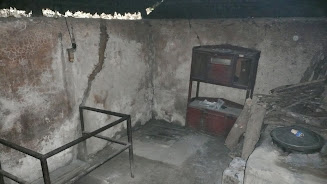
Comfortable underground kitchen with easy access to a tunnel,
The opening with the fence around it to protect tourists.

Photo
Of the many myths and truths from the history of the 1950s-1970s, one at the top or damned close to the top of any list is the Vietnamese guerrilla war area called the Cu Chi tunnels.    Leanna and I got to visit the national military reservation or park that contains the tunnels and related historic displays. We have heard repeatedly since our arrival that the people of Cu Chi are a special source of pride and inspiration for all of Vietnam. We visited three different park areas and drove by several more. Following are our impressions and some of what we learned about this amazing history.
The town of Cu Chi lies north and west of Ho Chi Minh City but seems like a suburb because the spread of HCMC is so extensive. After about an hour's drive we turned off the main highway to follow a smaller highway for a few miles. We pulled into a military area and parked next door at a large restaurant – at the banks of the Saigon River. You pass through a large, modern tunnel to enter the actual Cu Chi preserved/restored park and tunnels. After emerging in the park area we joined with a group of Malaysians to make a tour group lead by a young man dressed in khaki green. The first tunnel we looked at was entered by a SMALL rectangular hole that a person could drop down into if the alarm were given. I dropped in to have a look-see but it was immediately evident that I couldn't go out into the tunnel that connected to the entrance, it was too small for someone my size (about 5'8 1/2 and 150 lbs – I have lost weight since coming to Vietnam) but our guide told us that there were tunnels enlarged so that tourists could share some of the experience of moving and “living” underground. Just a couple of awe inspiring facts: the Cu Chi underground was built by Vietnam patriots (regular working people men, women, children of all ages) from the Cu Chi area in the years from 1948 to 1965 although it was used right up to the fall of Saigon in 1975. The people of Cu Chi are proud of their ancestors and martyrs who died in the war of liberation as well of the tunnel network they built to help defeat the French and the US. Maintaining the Cu Chi area free of USA control was seen as vital to the liberation of Saigon. The underground tunnel network totaled 200 kilometers, or about 120 MILES! This matrix was built by human toil,sweat and blood without big fancy machinery but hand tools: picks, shovels, wheel barrows, a bamboo woven carrying device that looked like a cement hod and the like. The tunnels were constructed at 3 levels: the fighting level was at about 6 foot underground and was constructed so that Viet Cong in their “black pajamas” based on a traditional clothing style of the country folk called an ao baba, a cousin of the ao dao (ow zi, the i is pronounced like a long i and the d is pronounced as a z more or less) could fire on the enemy and when things got hot dive in the tunnel and crawl to another port hole where they could pop up and continue to fight or flee to fight another day. The tunnels were not constructed in straight lines but had twists and turns to stop the force of explosions and prevent the deaths of the soldiers and support personnel in a tunnel (the blast would run into the wall and be weakened but there were still casualties). The brave US troops would spray flaming petroleum fuel into the tunnels with flame throwers in their attempt to defeat the enemy. Of course they killed old people, women and children   burning them alive. And in the US we have heard about the tunnel rats of our US Military who would brave the tunnels seeking the enemy but the enemy had disappeared by the time the GIs went down into the tunnel and this saved many American lives. On the other hand there were many booby traps that injured our US troops. In one building we were given a lecture on several types of booby traps that were deployed against the invaders. The main thing that can be said is that traps were made from local materials such as bamboo, other forest products, and the technology the people had used for thousands of years to trap animals. [Now as the guide said they trapped the enemy]. The Viet Cong also re-manufactured captured French and American bombs, cannon shells, other weaponry, rockets, tires, blown-up tanks and other vehicle parts etc to make weapons in factories in the tunnel complex. Our guide stated that “We recycled everything”, it made you think of an ecology group getting a tour on recycling except in your eye you saw weapons being cut to pieces and then re-assembled into much less sophisticated but effective weapons. There were as we mentioned two more tunnel levels, one at about 10 foot and the other at about 18 foot depth. Parts of the “fighting level” could be destroyed with cannon fire or grenades so when under attack the Vietnamese could drop down slanted entries to the second level where they were safe from most weapons. The lowest level at about 18 foot were safe from the carpet bombing of the B52s with 500 kilogram bombs. At this level people could survive terrible weapons of mass destruction although casualties were enormous. There were 47,000 military deaths (does not count all the civilians) in this small area, almost equal to the total of all Americans killed during the war.


Photo
Trying out a tunnel entrance, not much room.

All of life was not spent underground. The village of Cu Chi, original population 18,000, had dug out buildings/bunkers for tunnel workers and their families, schools for the children, a small hospital, eating rooms for communal meals, kitchens, weapons manufacturing areas where we watched how American bombs were turned into weapons to fight the invaders, a clothing and “shoe” manufacturing plant where the workers turned used tires into sandals. While we watched an operator used the equipment to make shoes like the ones that I bought. (The sandals I bought are made from recycled pieces of auto tire for the sole and heel and inner tube strips for the top straps. I put them on and worn them them the rest of the day to walk a mile in another persons shoes to know her life in a small way.) The living quarters and other buildings now rebuilt are both above and below ground level so that us tall foreigners can get in and out easily, but in the day the buildings did not protrude above ground or just barely above ground level so that the jungle canopy would make them invisible. Not protruding above ground also offered some protection from the blast of bombs that exploded near by – the blast would travel horizontally above the dug out buildings and the building would survive to be used again. The folks in the buildings would run into the tunnels as soon as there was an alert and head down to safety. Every building had an alarm or alarms made of pieces of bamboo that could be struck with sticks to make a racket and warn other buildings. Indeed sections of the tunnels have been enlarged for people Leanna's size and equipped with electric lights so that you can careful climb down into the first two levels of the tunnels and move through the tunnels for around 150 feet. Even that short distance is overwhelming in a crouched position when you know you're headed toward an exit. Incidentally we saw a lot of bomb craters left from the carpet bombing by B52s and other US aircraft. Chemical warfare was used extensively on Cu Chi --- is Henry Kissinger and our generals and officer staff up there with Adolf Eichman and the other NAZI swine? You will have to answer but it is a hell of a question. As I remarked recently on Facebook, our troops shouldn't be put in the position of killing others to satisfy the desires of the ruling classes of our nation – who make damn sure their kids don't go, [think “Dick” Chaney and George W. Bush for example.].
The second area we visited was a reconstruction of the original Cu Chi village so we could get a feel for the history of the area and people from 1960 through 1975. First we saw typical bamboo-sided, thatched roof houses with rooms for sleeping, cooking, eating with storage as well as wooden houses of similar size but made with sturdy wood and more substantial furniture – the relatively rich. There were plentiful fields of rice and vegetables, grazing, bamboo, livestock. A school was proudly built and in full use by 1965 for the village children. There was a market, village meeting house and a modest health clinic. After the defeat of the French colonialists, the Cu Chi area remained solidly Viet Cong/anti-USA imperialism so the tunnel system connected all buildings, houses, public areas, work areas, school and clinic. As we continued walking we entered an area depicting the village during the increasing USA war when heavy bombing and troop invasions took place. At this point houses and buildings became bunkers as described above all connected by tunnels.  Since this USA strategy of carpet bombings and toxic defoliants did not stop the Vietnamese resistance in Cu Chi, the USA then constructed concentration camps and attempted to force the people of Cu Chi into the so-called “strategic hamlets.” The USA then used more carpet bombing, Agent Orange and bulldozers to demolish the land, vegetation, village above ground structures, etc. As we walked through the area of bomb craters, un-restored land and destruction and desolation dotted with tunnels, it was sobering. Yet the people of Cu Chi continued to fight off the USA military and provide a launching area for successful liberation using the tunnels and their creative commitment to independence, freedom and happiness. Today 38 years later it is amazing to see bamboo and other trees (peanut, rubber, fruits, etc.) growing again with healthy vegetables, rice fields. The resilience of Vietnam's people and land is inspiring.
Our final stop was the Ben Duoc Martyrs' Memorial built from 1993 until 1995 as a tribute to the more than 47,000 military dead from the area. We were visiting on an anniversary day of the Vietnam military so there were special ceremonies honoring the heroes of the American War. It was very moving to see the huge statue of Ho Chi Minh and the innumerable golden plaques listing each dead revolutionary. The outside walls of the memorial was covered with beautiful mosaics depicting the history of Vietnam. The buildings are surrounded by quiet gardens with many trees planted in memory of individual soldiers as well as a large fountain shaped like the lotus flower – the entire memorial overlooks the Saigon River.

           There were many times during the Cu Chi visit that were painful and uncomfortable for us as Americans. The guides and installations were very straight forward and we were treated with sincere respect. The facts spoke for us. There were also moments of intense inspiration at the strength, resilience, depth of political commitment, vision and thirst of the Vietnamese people to win and shape their own future. We came to Vietnam thinking we had a solid foundation and understanding of the history of Vietnam. Cu Chi has taught us that there is so much more to learn about and from the Vietnamese people and their examples for the world historically and now.

We will share more pictures in a second post on this subject in the next few days.
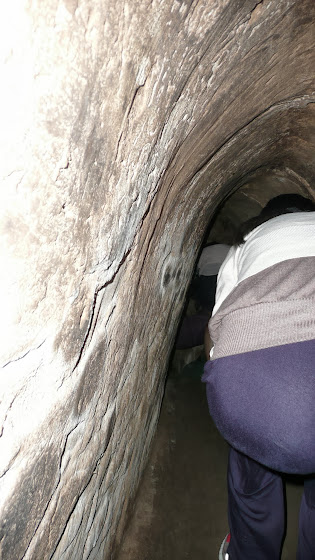
The woman ahead of me moving through
the enlarged tunnel, made so us
big people can get through!
The hole at the top right into the wall of the room is a tunnel entrance,
original size and I can't picture myself trying to run from falling bombs into
that tunnel, but people did it to survive.